
Every year, hundreds of thousands of truck crashes occur on American roads, leaving thousands dead and tens of thousands injured. Understanding truck accident statistics is essential for anyone concerned about road safety—whether you’re a policymaker, a commercial driver, or someone who simply shares the highway with 80,000-pound tractor-trailers.
These numbers tell a story that goes beyond abstract data. They reveal patterns in how, where, and why crashes happen, and they point toward what victims and their families need to know when pursuing fair compensation after a devastating collision.
Overview of Truck Accident Statistics in the U.S.
Before diving into the data, it helps to clarify what we’re talking about. When federal agencies like NHTSA and FMCSA discuss “large trucks,” they mean vehicles with a gross vehicle weight rating of more than 10,000 pounds. This category includes semi trucks, tractor-trailers, box trucks, and other commercial vehicles used for freight transport.
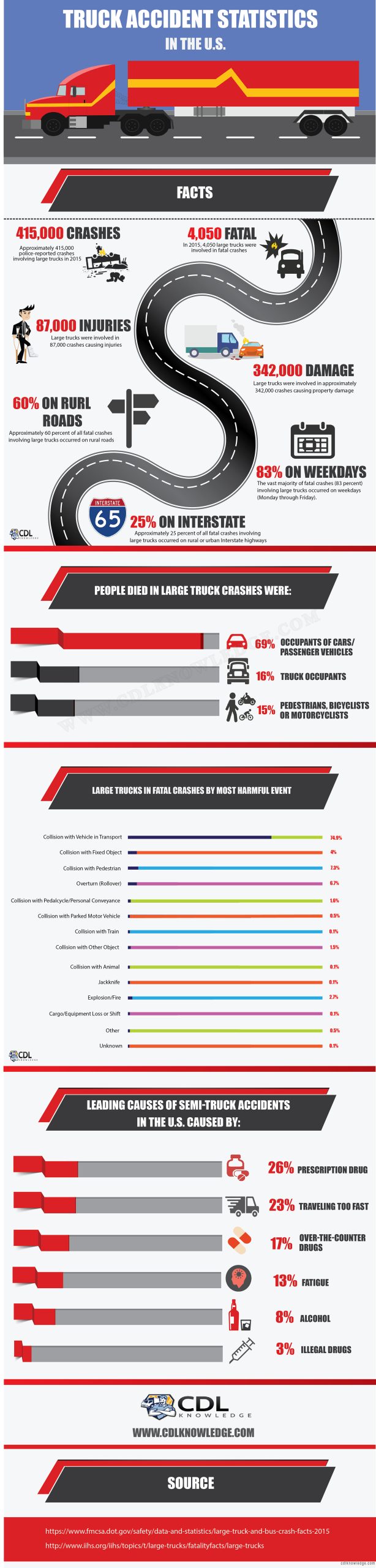
According to FMCSA data, there are an estimated 494,000 police-reported large-truck crashes annually in the United States. These collisions result in approximately 5,700 fatalities and 110,000 injuries each year—numbers that underscore the severe consequences of these incidents compared to typical passenger vehicle crashes.
What makes these statistics particularly striking is the disproportionate risk. Large trucks represent roughly 4% of registered vehicles on American roads, yet they’re involved in approximately 10% of all traffic fatalities. Fatal truck accidents are nearly five times more likely to result in death than the average motor vehicle collision, due to the sheer mass, size, and extended stopping distances of commercial vehicles.
How Large Trucks Differ from Passenger Vehicles
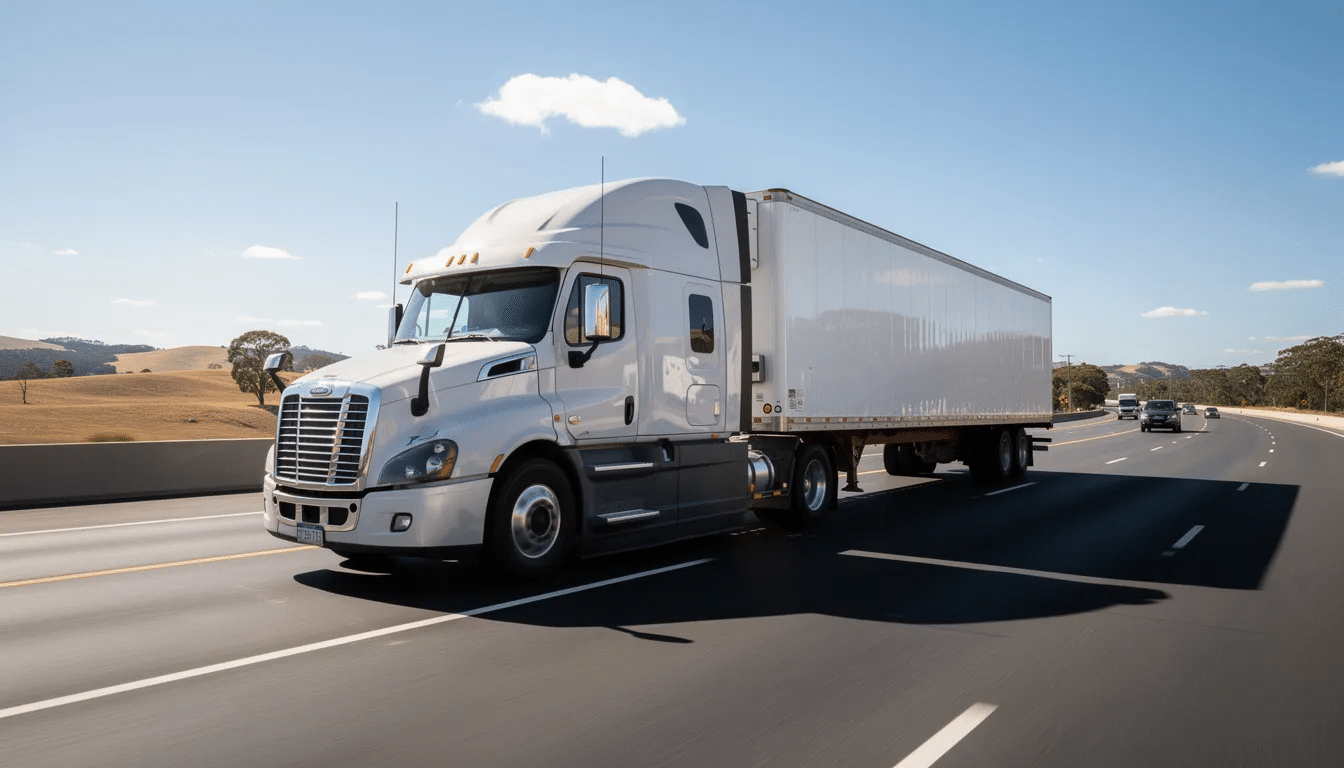
The physics of a collision between a large truck and a passenger car makes these crashes uniquely dangerous. A fully loaded tractor-trailer can weigh up to 80,000 pounds—that’s roughly 20 to 30 times the weight of a typical passenger vehicle, weighing 3,000 to 4,000 pounds.
This massive weight difference can lead to catastrophic outcomes in collisions. Large trucks have greater ground clearance than passenger cars, which increases the risk of underride crashes where smaller vehicles slide beneath the trailer. In these scenarios, the roof of the passenger vehicle can be sheared off entirely, causing fatal injuries to occupants.
Stopping distance presents another critical difference. Tractor-trailers generally need 20% to 40% more distance to come to a complete stop than passenger vehicles traveling at the same speed. On wet and slippery roads or when trucks have poorly maintained brakes, this gap widens dramatically. At highway speeds, a fully loaded semi truck may need the length of a football field or more to stop safely.
Visibility compounds these challenges. Large trucks have substantial blind spots—often called “no-zones”—on all four sides of the vehicle. Truck drivers cannot see smaller vehicles positioned in these areas, making lane changes and turns particularly hazardous. Combined with reduced maneuverability and higher rollover risk in sharp turns, these factors explain why large truck crashes so often result in fatalities for occupants of other vehicles.
Recent National Truck Accident Numbers and Trends
Truck crash totals have remained troublingly high throughout the 2020s, though recent data shows some encouraging signs. After years of increases, fatal crashes involving large trucks have begun to decline from their recent peaks.
In 2021, approximately 5,700 to 5,800 people were killed in crashes involving large trucks nationwide. The following year, 2022, saw 5,375 large trucks involved in fatal crashes—still a substantial figure but representing an 8.4% decrease from the prior year. Preliminary 2023 data from NHTSA indicate fatalities continued dropping to around 4,890.
Large trucks are involved in roughly 6% to 8% of all fatal traffic crashes each year, yet fatalities in large truck accidents now account for approximately 11% to 14% of total motor vehicle deaths, depending on the year and dataset used. This disproportion highlights the severity of these collisions.
Looking at longer-term trends, from 2016 to 2022, fatal crashes involving large trucks and buses rose 26.4%. However, when adjusted for the dramatic increase in freight volumes and vehicle miles traveled during this period, the picture becomes more nuanced. The fatality rate per 100 million vehicle miles traveled has remained relatively stable, even as total fatality counts increased with expanding truck traffic.
NHTSA’s January-September 2025 estimates project 27,365 total traffic deaths nationwide, down from 29,245 the prior year. The fatality rate per 100 million vehicle miles traveled dropped 8.6% to 1.06—the lowest mid-year rate since 2014—even as total miles traveled rose by 12.1 billion.
Who Is Killed and Injured in Large Truck Crashes?
One of the most sobering aspects of truck accident statistics is who bears the brunt of these collisions. The vast majority of people killed in crashes involving large trucks are not truck occupants—they’re occupants of passenger cars, pedestrians, bicyclists, and motorcyclists.
In 2021, approximately 5,788 people died in large truck crashes. Of those killed, roughly 72% were occupants of other vehicles. Large truck occupants killed accounted for approximately 17% to 18% of fatalities, with the remainder being pedestrians, bicyclists, and motorcyclists.
The injury statistics follow a similar pattern. National data indicate that more than 150,000 people are injured in large truck crashes each year, and only a minority are large truck occupants. In two-vehicle collisions between a large truck and a passenger vehicle, an overwhelming share of deaths—around 95% or higher—occur among occupants of the smaller vehicles.
Motorcycles and pedestrians face heightened vulnerability. When these road users are involved in collisions with large trucks, the outcomes are almost universally catastrophic due to the complete lack of protective barriers.
Where and When Truck Crashes Happen
Large truck crashes are not randomly distributed across America’s roadways. Certain road types, times, and locations see far higher concentrations of serious incidents.
Regarding road types, roughly half of large truck crash deaths occur on major non-interstate roads—approximately 51% based on recent distribution figures. About 34% happen on interstates and freeways, with the remaining 15% occurring on minor roads. This distribution reflects where commercial freight moves and where high-speed traffic intersects with local traffic patterns.
The urban-rural divide matters significantly. Many fatal truck crashes occur on rural highways where speeds are higher and emergency response times are longer. However, metropolitan freight corridors with high traffic volumes also see elevated crash rates simply because of the sheer number of vehicles involved.
Time-of-day patterns differ notably from other motor vehicle crashes. A large share of fatal truck crashes occur during daytime working hours—nearly half of large truck crash deaths happen between 6 a.m. and 3 p.m., compared with a smaller proportion for non-truck crashes. This makes sense given that most commercial trucking operations run during business hours.
Weekend patterns also stand out. Only about one in five large truck crash fatalities occur on weekends, reflecting the weekday concentration of commercial trucking activity. Most truck accidents happen Monday through Friday when freight moves most heavily.
State-Level and Regional Hotspots
Certain states consistently record higher numbers of fatal truck crashes, particularly those with major freight corridors, large rural highway networks, or significant port activity.
Texas leads the nation in truck-related roadway deaths. In 2022, Texas reported over 580 truck-related fatalities, with similar levels in surrounding years. This isn’t surprising given the state’s size, extensive highway network, border crossings, and position as a central hub for American freight movement. Major metro areas like Houston and Dallas-Fort Worth see particularly heavy truck traffic and elevated crash risk—Harris County alone reports thousands of large-truck crashes annually.
California, Florida, and other large industrial states also rank among the highest for total truck crash fatalities, reflecting their roles as freight hubs and their sheer population size. California reported 13,612 large truck crashes in 2022, including 465 fatal crashes resulting in 514 deaths.
At the per-capita level, the picture shifts. Wyoming ranks as the most dangerous state with a fatal truck death rate of 2.89 per 100,000 population and the highest nonfatal crash rate at 143.29 per 100,000. Great Plains and Mountain West states—including South Dakota, Kansas, Nebraska, North Dakota, and Montana—cluster as high-risk areas, along with Southern states such as Louisiana and Mississippi.
The deadliest highway corridors are major interstates that handle freight. In 2024, I-35 in Texas recorded 38 fatal truck crashes, I-40 in New Mexico had 37, I-10 in Arizona reported 32, and I-40 in Tennessee saw 21 fatal collisions.
Common Types and Causes of Large Truck Crashes
Most large truck crashes involve multiple contributing factors, but certain patterns appear consistently across federal and state crash data.
Common crash scenarios include rear-end collisions (with the truck either striking or being struck), side-impact and angle crashes at intersections, underride crashes, jackknife incidents, and rollovers. Rear-end crashes rank among the most frequent crash types involving large trucks, largely due to the extended stopping distances required and the congested conditions on many highways.
The primary contributing factors fall into several categories:
Factor Category | Examples |
|---|---|
Speed-related | Speeding, driving too fast for wet roads or traffic conditions |
Following distance | Tailgating, inadequate stopping distance |
Driver fatigue | Hours-of-service violations, drowsy driving |
Distracted driving | Phone use, in-cab technology, and eating |
Lane violations | Improper lane changes, failure to check blind spots |
Equipment failure | Brake problems, tire failures, and unsecured cargo |
NHTSA and FMCSA crash causation research has estimated that driver error—from both truck drivers and other vehicle operators—accounts for the majority of large truck crashes. Many drivers violate speed limits or fail to maintain following distance requirements, while others drive while fatigued after exceeding hours-of-service regulations.
Equipment issues also contribute significantly. Wyoming’s data show 41.18 equipment-related crashes per 100,000 population, highlighting vulnerabilities in maintenance and cargo-loading practices among some motor carriers.
Why Truck Crashes Are Often So Severe
The physics of an 80,000-pound vehicle colliding with a 3,500-pound passenger car explains why so many truck accidents result in catastrophic outcomes. The massive weight and momentum of a loaded rig mean exponentially more energy transfers during a collision compared to a typical car-to-car crash.
Rollover crashes pose particular dangers for large truck occupants. A significant share of fatal truck occupant deaths occur in rollover incidents, at rates higher than for passenger vehicles like cars and SUVs. The high center of gravity on loaded trailers makes rollovers more likely during sharp turns, sudden maneuvers, or when drivers lose control.
Underride crashes are among the most devastating types of collisions. In these scenarios, the passenger vehicle’s front or side is crushed or sheared off as it impacts the truck’s frame or trailer. Occupants of the smaller vehicle often suffer fatal head and chest injuries before any other safety systems can engage.
Vulnerable road users face amplified dangers near commercial trucks. Pedestrians, bicyclists, and motorcyclists near turning or backing trucks encounter heightened risks because of large blind spots and the vehicle’s height. When collisions occur, property damage becomes secondary to the severe—often fatal—personal injuries sustained.
Safety Efforts, Regulations, and What Victims Can Do
The federal and state safety framework governing commercial trucking has evolved significantly over the past two decades. FMCSA regulations cover hours-of-service limits, weight restrictions, mandatory maintenance schedules, and driver qualification standards, designed to reduce the risk factors contributing to crashes.
Key safety technologies now common or emerging in the trucking industry include:
Electronic logging devices (ELDs) to prevent hours-of-service violations
Automatic emergency braking (AEB) systems
Lane-departure warning systems
Electronic stability control
Improved underride guards
Enforcement campaigns, including roadside inspections and targeted speed enforcement on truck corridors, aim to identify high-risk behaviors and defective equipment before crashes occur. Massachusetts, for example, shows what strong enforcement looks like—the state has the lowest driver drug/alcohol violation rate (0.35 per 100,000) and some of the strongest equipment compliance numbers nationwide.
Practical Tips for Sharing the Road
Motorists can reduce their risk around large trucks by following these practices:
Avoid blind spots—if you can’t see the truck’s mirrors, the driver can’t see you
Leave an extra following distance behind trucks
Never cut in front of a truck; remember its extended stopping distance
Anticipate wide turns and give trucks room at intersections
Pass quickly and decisively; don’t linger alongside a tractor-trailer
What to Do If You’re Injured in a Truck Crash
After a serious truck accident, taking the right steps can protect both your health and your legal rights:
Seek immediate medical care and document all injuries thoroughly
Preserve evidence, including photos of the scene, dashcam video, and witness contact information
Report the crash to law enforcement and obtain the official crash report
Keep records of all medical bills, lost wages, and other expenses
Consult an attorney experienced in commercial truck cases
Truck accident lawsuits differ significantly from typical car accident claims. Trucking companies often have teams of adjusters and attorneys working to minimize liability immediately after a crash. Multiple parties may bear responsibility—the driver, the trucking company, the vehicle manufacturer, or the shipper who loaded cargo improperly.
An experienced law firm can investigate liability, identify all applicable insurance coverage, and help victims pursue compensation for medical expenses, lost earning capacity, pain and suffering, and other damages. Most offer a no-obligation consultation to discuss your case.
Key Takeaways
Statistic | Figure |
|---|---|
Annual police-reported large truck crashes | ~494,000 |
Annual fatalities in truck crashes | ~5,000-5,700 |
Annual injuries in truck crashes | ~110,000-150,000 |
Percentage of fatalities who are non-truck occupants | ~72% |
Weight of loaded tractor-trailer vs. passenger car | 20-30x heavier |
States with the highest total truck fatalities | Texas, California, Florida |
Understanding truck accident statistics in the U.S. helps everyone—from policymakers crafting safety regulations to drivers navigating busy highways to families dealing with the aftermath of a devastating collision. The data shows clear patterns: large truck crashes remain disproportionately deadly, most victims are occupants of other vehicles, and certain highways and regions see concentrated risk.
If you or a loved one has been injured in a truck accident, remember that these cases involve complex liability questions and often substantial damages. The American Trucking Association reports that commercial trucking remains essential to the economy, but that doesn’t diminish the rights of people injured by negligent drivers or poorly maintained vehicles. Seeking experienced legal guidance early can make a significant difference in your ability to recover fair compensation and move forward after a life-changing crash.